

Two versions of you are fighting for control.
An engineer-turned-neuroscientist explained why one keeps winning.


Why does your brain keep sabotaging the life you want?
You’ve probably caught yourself doing this:
You want to spend less time online… but end up scrolling on social media.
You know you should go to sleep… but keep telling yourself “just one more video“.
You sit down to work, and suddenly you’re lost in your notifications.
The frustrating part is that you genuinely want to change. But in the moment, doing the opposite feels surprisingly easy, almost automatic.
It’s almost as if there are two versions of you living inside your head: one chasing your goals and the other pulling you down whenever you try.
I wanted to understand why, so I looked deeper into what was happening inside my brain, and also discussed it with an expert. The reason turned out to be far more interesting than ‘laziness‘.
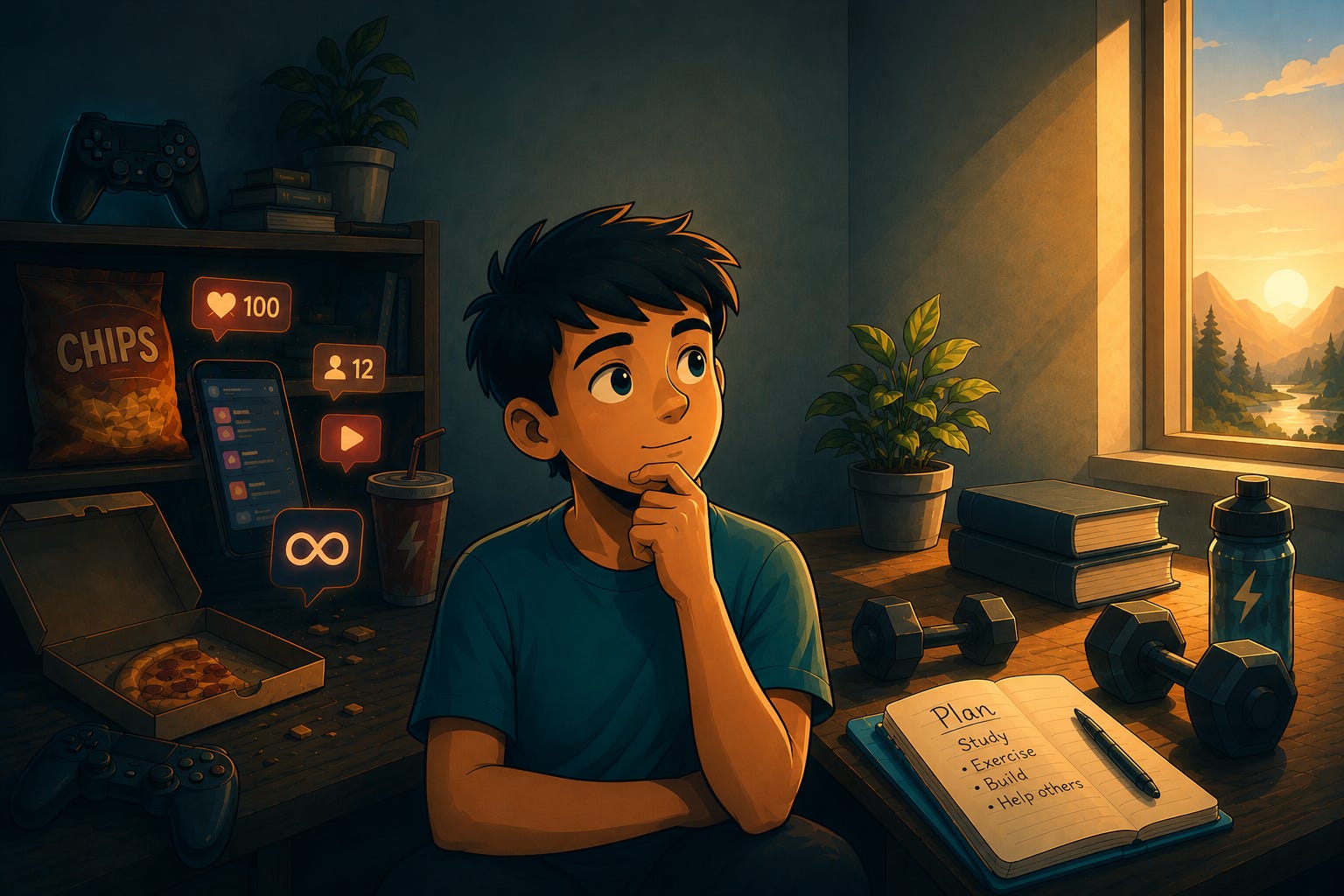
To understand why your brain sometimes seems to fight against you, first you need to understand one of its important systems: the reward system (and dopamine).
I wanted to avoid being superficial about the topic and truly understand what’s going on, so I reached out to engineer-turned-neuroscientist, Juliette Ryan.
Juliette has a PhD in engineering, and later became interested in understanding the human brain through both studies and experiments. She’s an active Substack creator, helping people engineer a better mind.
I asked Juliette one simple question:
What is dopamine, and how does it work?
This was how she explained it:
“Dopamine isn’t (just) about pleasure, or anticipation or rewards.
It’s actually about learning.
Your brain is a prediction machine, constantly trying to forecast what is coming next. Dopamine is the neurochemical that runs this prediction machinery. […]
When something unexpectedly good suddenly happens to you – you find money on the road, […] or you taste an unexpectedly good dessert – that’s something your brain did not predict. […]
It’s like a positive glitch in your timeline, and it triggers a dopamine spike within your limbic system that updates your brain’s future predictions. Where you were, what you were doing, how you felt… your brain uses all of this information to predict when that good thing might occur again in future.
When you come across one of these cues – the same point on the road, or you see that dessert on the menu again – your brain triggers the second kind of dopamine spike: one that makes the prediction.
There’s a possibility that the good thing is about to happen again!
And crucially, this spike supplies you with the motivation to get that good thing. You expect it. It’s creating a self-fulfilling prophecy. […]“
To understand the following, you have to know that this system is much, much older than we are. It’s not something evolution can redesign in a few decades.
And this is the main problem with our reward system: humanity advanced so quickly that our biology simply couldn’t keep up. Modern life exploits this ancient system in ways it never evolved to handle.
This is why you can encounter many sources triggering dopamine that your brain logically shouldn’t encourage or reward:
Consuming endless social media feeds.
Highly processed, sugary, unhealthy foods and drinks.
Push notifications that create constant anticipation.
And the reason these are so effective and addictive comes down to one simple thing:
They’re outrageously easy and accessible.
Compare that to how rewards used to work:
Thousands of years ago, when you were hungry, you had to go and hunt. It took a lot of effort, but it increased your chances of survival, so your brain evolved to reward it.
Now?
Food, entertainment, and stimulation are always just one click away.
The reward system isn’t broken: it functions just as intended.
Another question I asked Juliette was this:
What’s the key to a healthier reward system?
Her answer boiled down to one very simple shift:
“Trigger your own dopamine more than your environment does. […]
When your alarm goes off and you reach for your phone, that’s a predictive spike of dopamine making you feel compelled to start scrolling. […]
Any time you get a sudden urge to do or have something, look to your environment and see what triggered that spike of dopamine. Then crucially, don’t follow it. This will weaken the influence of external triggers of dopamine.
At the same time, do things that trigger your own dopamine.
Whenever you use your brain or body in an effortful way, you trigger your own dopamine both within the reward system of your brain and also the cortex. […]”
Reading this confirmed something I suspected for a long time.
There are different ways dopamine can be triggered, and while the chemistry is identical, your brain learns very different things from each:
Environment-triggered dopamine often comes from sources that require almost no effort. Over time, this makes your brain predict rewards from easier and easier actions.
Self-triggered dopamine, however, has to be earned through your efforts, and it comes with real benefits, as Juliette explained:
“You can program your own brain to find your effortful actions rewarding, energising even. You can even program your brain to find pleasure in the process, not just at the finish line. In fact, the more you trigger your own limbic and cortical dopamine, the more creative and insightful your mind will become.”
That’s one side of it. The other is what happens to motivation once you reduce environment-triggered dopamine: it becomes significantly easier to begin tasks that promise smaller, delayed rewards.
Why?
Because your brain stops comparing those smaller rewards to the endless feeds, junk food, and other highly stimulating alternatives that desensitized your reward system.
All of this made me stop believing in dopamine detoxes: the goal isn’t to have less dopamine in your system, but to change the source it comes from.
Dopamine isn’t the enemy.
Dopamine is a tool, and if you know how to use it, a powerful one.
I presented my idea, which I call Reward Rewiring, to Juliette.
Instead of trying to eliminate dopamine, Reward Rewiring focuses on reducing the frequent, low-effort spikes of dopamine, shifting toward activities that require effort and create value.
This was her reply:
“This is a great strategy. […]
To use the brain’s reward system to your benefit, I would recommend trying to avoid any kind of ‘reward’ that doesn’t require some form of effort – cognitive or physical – to attain. If you want to scroll, that’s fine, but always do it after you’ve done something productive. And when you are in a position to passively consume something, try to use your brain. Don’t just scroll – look for something. […]
Most importantly, if you do ever passively consume, make sure you give your dopamine receptors time to recover afterwards. […]”
Before we go further, there’s another thing worth clearing up. The internet has created a lot of misconceptions about dopamine and the reward system, so I asked Juliette about the most common one she’s run into:
“Most people still mistakenly equate dopamine with pleasure.
But in actual fact, the ‘wanting’ (dopamine) system and the ‘pleasure’ (opioid) system are actually two different regions in the brain. They often overlap but they do sometimes come apart.
An addict can desperately want their vice without liking it. A person can enjoy a just-as-good-as expected dessert without wanting more of it.”
The ‘wanting‘ system doesn’t wait for the outcome: it can fire the moment your brain predicts a reward is coming, in anticipation, motivating us to take a certain action.
And anticipation is what leads to the final topic worth mentioning about dopamine in the self-improvement space that isn’t discussed enough.
This brings me to what I consider fake self-improvement:
Redesigning plans to make them more and more detailed,
Watching self-improvement content to fuel your motivation,
Learning without taking action afterwards.
Notice how all of these have one thing in common: they build anticipation.
That’s why motivational content is so addictive. That’s why redesigning your plan once more feels so productive. You feel like you’re making progress, because you’re triggering dopamine, without having to exit the risk-free zone of preparation.
So why does your brain keep fighting with you?
It isn’t. Your brain isn’t an enemy.
It’s following a reward system that worked brilliantly for thousands of years. It’s the world around it that changed faster than the system could recalibrate.
And instead of a dopamine detox, I encourage you to start Reward Rewiring:
Today, notice just one moment when your environment tries to tell you what to do. Maybe it’ll be your phone. Maybe a specific place in your room. Maybe the bag full of candy in your kitchen.
Pause.
Observe this moment, and don’t follow it automatically. Instead, replace it with something conscious. This is how you can start rewiring your reward system.
At the end of the post, I want to say a huge thank you to Juliette Ryan for taking the time to answer my questions and reviewing the scientific side of this article! I really wanted to share more than just my own opinions, and thanks to Juliette, this finally happened.
Juliette’s explanations were much more detailed than I could reasonably include here. If you’d like to read the full Q&A, including every question and complete answers, you can find it here: https://dub.sh/dopamine-qna
Understanding your reward system is just one piece of a much bigger puzzle.
Most people obsess over their goals, and they’re important: they’re the destination.
But before you worry about where you’re going, it helps a lot to build the vehicle that gets you there. This is what this publication is all about: self-improvement content that you can apply today to become a little better than yesterday.
If this sounds interesting, I’d love to have you along:
 | A guest post by
|
Zoli and Juliette, really enjoyed this one. 🙌
The wanting vs. liking distinction alone reframed a few things I'd been getting wrong about my own "motivation" for a while now.
And I could tell this wasn't just a quick take dressed up with science, the back-and-forth between you two comes through and it makes the piece feel earned rather than borrowed.
Thanks for putting in the work to get this right. 🌟
Great piece 💯
Hey Zoli and Juliette, thanks for sharing this piece and bringing it to our attention. Reading through it reminded me of doing kind of a 'dopamine audit' or a systems check in. Looking at how I'm wired and what motivates me to take action. I like the idea of not removing or detoxing, but harnessing or habit stacking the natural wirings of our bodies. First though, we need to identify and be more mindful of our own systems. Sometimes, I think we're all just driving down the road of life and we don't even recognize the check engine light on or maybe we see it and just keep driving. Over time, if not addressed, this causes our engine to work harder to compensate and I'm slowly realizing this isn't sustainable over the long term. So, thank you for this and I'm looking forward to reading more! 💚