

The first step to change your life.
How to rebuild trust in yourself, one promise at a time.

Most people fail in self-improvement the moment they begin.
And not because they’re lazy,
Not even because their plan isn’t perfect enough.

The real problem is deeper:
They no longer trust themselves.
Because if you quit after promising to yourself that you wake up early,
Or that you’ll start exercising,
Or that this Monday will be different,
You lose way more than just a streak.
You lose trust in your own word.
And after enough repetitions, you stop trusting yourself completely,
Because your experiences taught you how it ends: with quitting.
But why do you even quit in the first place?
Because your brain is wired to follow the path of least resistance.
You see, our body naturally wants to save energy.
That’s why whenever you face a difficult choice, you lean towards the easier option:
Ordering fast food over cooking something yourself,
Doomscrolling instead of exercising,
And staying in your comfort zone instead of chasing growth.
Your mind starts negotiating with you, trying to avoid the uncomfortable path:
Take the easy option!
You can rest longer, no need to start right now!
Skip today, you’ll start tomorrow!
If you lose these negotiations and let them control your life repeatedly,
Your self-trust slowly fades away, because you don’t feel in control anymore.
Not because you’re weak, but because you’re human.
Many people mistake this for laziness,
But in reality, it’s a habit of choosing comfort.
So if the problem is losing trust in yourself, the solution is restoring it,
And this is what most people get completely wrong.
Once they realize they need to change, they jump to extreme solutions:
A 90-day monk mode,
A complete dopamine detox,
A perfect morning routine,
A 10-year life vision.
The problem is, these approaches demand effort you can’t sustain right now.
It’s the same as realizing you’re physically weak,
And then going to the gym and attempting a world-record lift.
The point is, you won’t rebuild self-trust by making even bigger promises.
You can rebuild it by finally keeping smaller ones.
And this is where discomfort comes in.
You probably think discomfort is about suffering.
It’s not.
Discomfort has one simple purpose:
To convince you that you are in control.
Every time you willingly choose the harder option, you win a negotiation.
And every negotiation you win, no matter how small, becomes evidence.
Evidence that you can trust your word.
Evidence that you can choose the uncomfortable path.
Evidence that you are capable of doing difficult things.
That’s why discomfort works so well.
Not because suffering magically makes you stronger.
Because it rebuilds the belief that you still have agency over yourself.
How did I restore my self-trust?
Over the past month, I experimented with a simple system.
A 3-week phase with one goal: rebuilding trust in my own word.
On this journey, I had my most productive days I had in quite a while.
I wanted to make it as easy-to-follow and straightforward as possible,
So I refined it several times before deciding it was actually valuable.
The final version of the framework has just 2 rules:
Rule #1: Keep ONE promise
Choose one habit you can realistically repeat every day for the next 3 weeks.
The habit itself isn’t the most important part:
It’s staying consistent with it.
And every day you follow through is another piece of evidence that your word means something.
Rule #2: Win ONE negotiation
Every day, intentionally do something uncomfortable.
Something that triggers real resistance in your mind.
During this phase, I often used cold showers as my daily negotiation,
And if you ever had a cold shower, you know exactly why.
When your feet touch the cold water, your brain goes:
Man either turn off the water or make it warmer, I am NOT doing this.
That’s exactly what you want to hear every day from now.
Remember, the goal isn’t suffering.
It’s winning the negotiation.
And every time you choose the difficult option, you prove that comfort isn’t in charge anymore.
That’s how self-trust comes back.
What changes after 3 weeks?
Let’s set the right expectations,
Because this phase won’t change your life overnight.
It won’t make you rich, it won’t build your dream physique,
And it won’t magically solve every problem you have.
What it does is much more important.
1. It helps you build momentum.
Instead of restarting from scratch every Monday, you’re already in movement.
2. It helps restore trust in yourself.
Every promise you keep is more evidence that your word means something.
3. And it helps you become comfortable with discomfort.
The things that once felt impossible start to feel achievable with some effort.
This phase isn’t the finish line.
This is just the first step on your self-improvement journey.
The foundation everything later will be built upon.
Before you begin…
Why 3 weeks? Why not more or less?
Because it’s long enough to create meaningful change,
But short enough that most people can realistically commit to it.
The goal isn’t to build permanent habits yet.
It’s to rebuild your self-trust.
What if I miss a day?
Do NOT restart.
And don’t punish yourself.
You see, the problem isn’t missing one day (at the end of the day, we’re all humans).
The problem is turning a missed day into a habit.
If you slip up, simply make sure you don’t do it twice in a row.
Why not start with setting goals?
The first Art of Self-improvement is Direction, so this might seem backwards.
My reason is simple: taking action early is incredibly important.
And the beauty of this system is that it works before you know where you’re going.
Spend your first 3 weeks rebuilding your self-trust.
Then you’ll be in a much better position to decide where you concentrate your efforts.
Are you ready to rebuild your self-trust?
To make this 3-week period easier, I created a toolkit based on the system I used.
Inside, you’ll find:
A simple tracker you can use for the phase.
A library of habit and negotiation ideas I recommend giving a try.
A visual guide on how to start using it in less than 2 minutes.
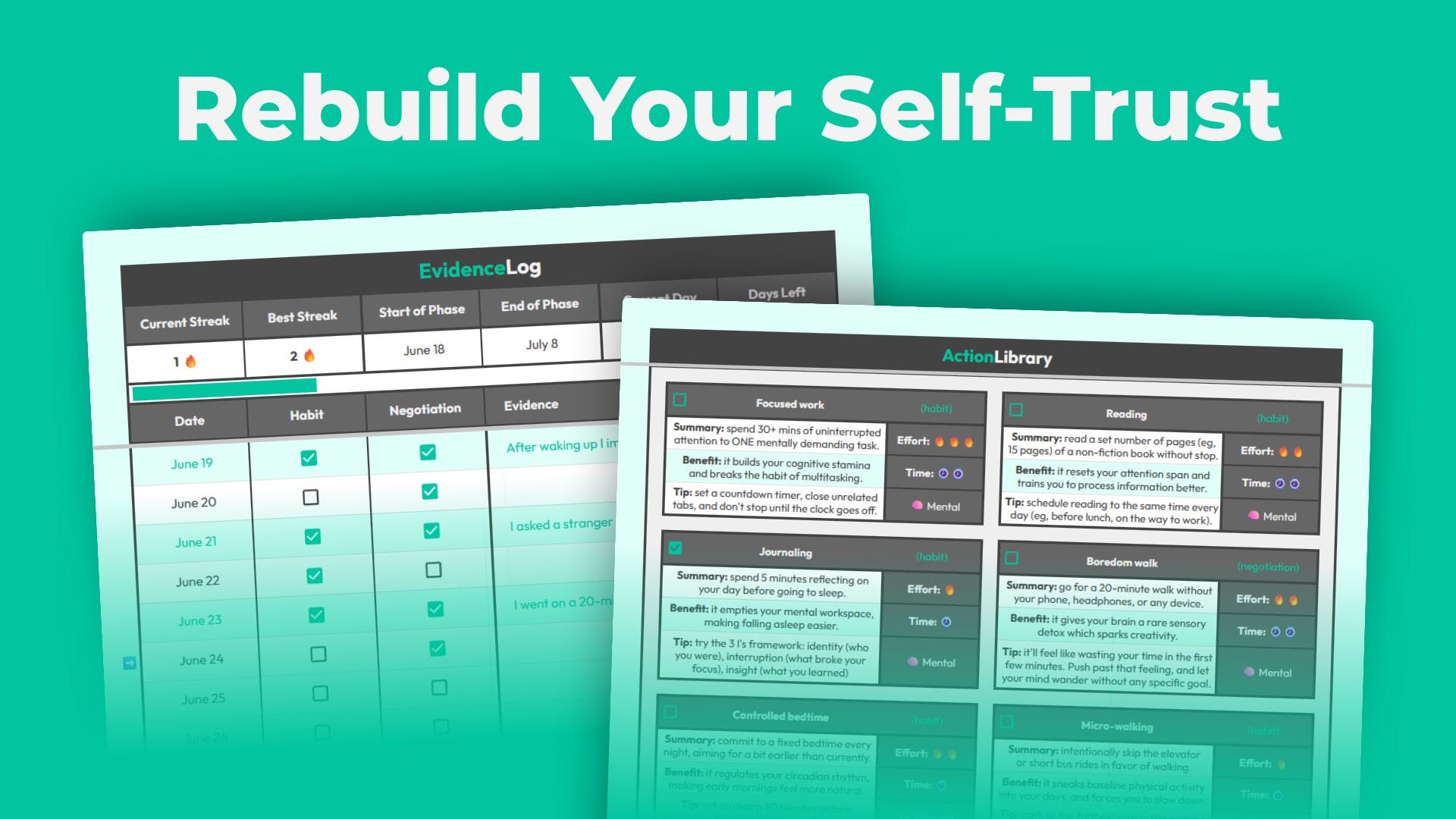
You can access it for free in my Subscriber Chat.
If you’re ready to stop restarting and start your journey for real, join us there.
I’ll see you inside.
Comfort wins by making the easy choice feel harmless. But those small choices add up fast.
I agree we are “wired” to take the path of least resistance. I have struggled with this myself. This is a great article, I really enjoyed reading it. Thank you for sharing!