

Forget Yearly Goals - This Works Better
Make long-term plans stick with this flexible plan.

Join the First 100
I’m challenging myself to reach 100 subscribers by the end of November 2025. If you want to be remembered as the foundation of this journey, join us!
You can find out more about the challenge here:

Most people set yearly goals. But a year is too long: halfway there, you've already lost momentum. That’s why I don’t plan in years. I plan in ‘Seasons’.
Hello! This is Zoli, the 16-year-old building a real business while balancing school, gym, and life. Today, I’ll break down my own long-term planning system. I’ll share my experience, how it works, and how You can achieve the same: stay consistent with long-term plans.
So, What’s a Season?
I came up with the idea at the start of my journey (July 2025). If I’m being honest, I just shot blindly, and I hit the target: I was able to complete about 90% of the plans I set 2 months before.
Since then, I reflected on my results and refined the system, and it’s better than ever.
This is how I’d answer “what a Season is” in a Wikipedia article:
2-4 months of structured progression in a few specific aspetcs.
But this is Substack, so let me explain how it truly works, as well as provide a few easy steps, so you can make your first Season today.
How to Build a Season in 10 minutes
Step 1: Frame your Season
Start by picking a timeframe. In my experience, 2-4 months is the best, but lock it in! (You can do what I started with Season 2, and connect it directly to the meteorological seasons.) Optionally, give it a creative (or non-creative) name to make it more official.
Step 2: Choose your aspects
Pick 2-4 main focuses for the Season, areas where you want to improve (this can be professional, a sport, something personal, anything)! This is a change I added with Season 2. After my first Season, I realized that one of the main reasons why I couldn’t get 100% is simply that I set too many goals, and my attention was split. I run Season 2 with 4 aspects, but later might even decrease this number.
Step 3: Set SMART wins
You’re probably familiar with the SMART criteria1 for goal setting. At this step, we simply frame our aspects with this method, because right now, they are really vague. The magic of this plan, that here you only have to do the “SMA“ parts of the criteria (in step 1, we covered Time, and in step 2, I assume you picked aspects that are Relevant to you). Read again each aspect you picked, and ask the following questions:
What step-by-step actions will mean progress toward this goal?
Which key metrics or indicators will show that I’m on track?
Do I have the skills, resources, and time to realistically reach this goal?
With this, expand or modify the aspects so they are SMART goals!
Step 4: Break it down into blocks
No matter how small a frame you picked for your Season (even if you went below the recommended), you can’t skip this step. You must clarify each aspect by breaking it down into blocks of 2 weeks. I personally chose biweeks because I found single weeks too strict, 4 weeks too loose, and 3 weeks…well, too cursed. You don’t have to plan exactly with biweeks: you can change up any specific in this system to experiment. The main point: break it down into smaller milestones!
Step 5: Run, reflect, regulate
With this, you have the complete plan for your first Season! All you have to do now is start. But don’t just mindlessly do the tasks. After finishing a block, spend some time reflecting on your performance.
What did you succeed with?
What went wrong? Why?
How can you do better in the next block?
Take a look at your accomplishments and your seasonal goals, and compare (while keeping the frame in mind)! If you realize that your plans weren’t really SMART goals, adjust your next block, or even your seasonal plans. The motto here:
Don’t limit, just regulate!
What do I mean by that? If you see only a small sign of failure, don’t adjust yet. Making adjustments should be the last option when you can’t possibly make it. Despite having a near all-time-worst performance last week, I still didn’t change my plans, leaving the opportunity open to catch up.
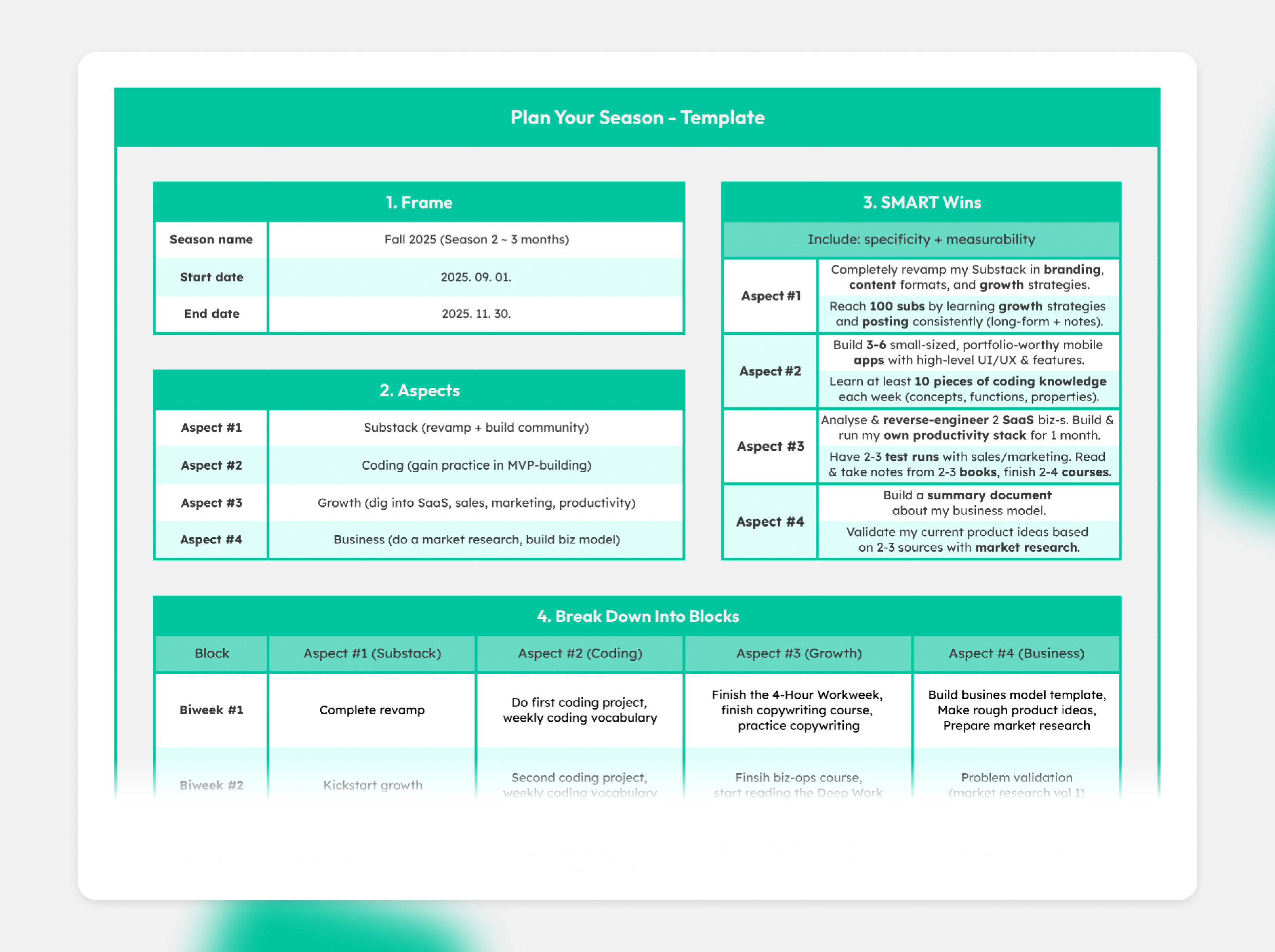
Here’s how my plan looks for my second Season:
Why the Seasons Work
If you’re still not convinced, let’s list a few productivity facts that prove that this system works (if my personal experience isn’t enough):
1. It keeps momentum high: based on Parkinson’s law (“work expands to fill the time available“). Because of the block structure, each Season has short deadlines, which feel urgent. Urgency builds focus.
2. It’s a highly flexible system: this is why reflection is so important. By analyzing your progress every few weeks, you can notice and solve problems quickly, before they cause total failure.
3. It keeps everything smart: the Seasons are built on the foundation of SMART goals, which is one of the most globally recognized ways of setting goals you’ll truly achieve. The system is basically an upgrade of SMART goals.
4. It keeps momentum high (again, but from a different perspective): research on the “Fresh Start Effect“ has shown that people are more motivated when there’s a clear new beginning. Every single Season (and even block - if you do it cleverly) is viewed as a new start by your mind.
If You Feel Like Planning Your First Season…
…I’ve got a great surprise for you!
I built a special Google Sheets template just for this post to help you create your first Season step-by-step, along with a few extra tips & tricks. It’s available to every subscriber for free! Here’s how to get it:
If you already subscribed, DM me, and I’ll send it to you2 ASAP.
If you aren’t a subscriber yet, even easier! Just subscribe, and you’ll find the link in your welcome email.
What’s one goal you’ll include in your first Season? Drop it in a comment!
That's it! You can now start building your first Season!
I have many more tools & knowledge I want to share with you. If you have any ideas or specific interests, let me know!
Enjoy reaching the goals you’ve only dreamed of so far!
Zoli
If not, here’s a summary, just so you understand it: a good goal has to be Specific, Measurable, Achievable, Relevant, and set to a Timeframe.
By next week’s Toolbox post, I’ll have a better way of doing this, so it is automatic for everyone. Until then, please be patient. If you know a solution, let me know! The copy-paste-fill template is already available, but I’m still working on the tips & tricks cheat sheet, so you can expect a few updates to the template over time.