

You're chasing the wrong goal.
Most goals are just guesses. Here's how to test if yours measure up.

Imagine if I told you:
I’m buying a Ferrari because I want to climb a mountain.
It sounds completely absurd: why choose a Ferrari to climb a mountain, instead of, say, an SUV? Yet, we do something very similar when it comes to our goals.

Previously, I explained why everyone should start their self-improvement journey by improving their relationship with discomfort. By keeping your small promises, it becomes easier to stick to the plan, even if it isn’t the easiest route.
But discomfort only makes sense if your actions get you where you want to go. So, before we get any deeper, we need to clean up something:
You probably misunderstand how goals work.
Because what you think of as goals are only half of the picture: every goal is actually a connection between a desire, and a route. And most people are only aware of the latter, which they call their “goal.”
Most routes can be traced back to a deep, underlying desire people want to satisfy. The route is simply your current best guess, that might satisfy that desire once you cross the finish line.
This is why some goals feel strangely empty once you achieve them: you successfully followed the route, but it was never leading toward your desire.
As an example, let’s use the most widespread fitness goal people have: losing weight. This might sound counterintuitive, but most people don’t really want to “lose weight.“ What they really want might be:
To be more confident in social situations,
To feel healthier and more comfortable in their bodies.
Their goal was never really to lose weight for the sake of losing weight. They made an unconscious guess: “If I lose weight, I’ll be more confident.“
And I’m not saying that losing weight is a wrong route to confidence, because it isn’t. What I’m saying is that we often guess wrong, and are trying to satisfy our desires by following routes that’ll never get us there.
To uncover the desire behind a route, and test whether the chosen route can realistically satisfy it, I created what I call:
The Route Audit
It’s a three-stage framework designed to (starting from your current route) uncover your underlying desire and tests your route with a few simple exercises.
To provide a clear example, I decided to audit one of my own goals: bench pressing 4 plates (being an amateur powerlifter, this is a big dream I have). And for the record, I was convinced this route was genuine until I ran it through the framework.
Stage One: Excavate the desire
You follow a route because you believe it’ll satisfy something deeper. The first stage of the audit is figuring out what that “something“ is. Maybe you already have an idea, maybe you’re clueless.
Ask yourself one simple question:
“What would happen if I achieved that?”
Begin with your route, write down the answer. But don’t stop yet. Every time you answer, go another step deeper. Here’s what that looked like in my case:
What would happen if you achieved a 4-plate bench press?
I would reach a level in strength close to my maximum natural potential.What would happen if you achieved your natural potential?
I would become the best version of myself in a relevant aspect of my life.What would happen if you achieved the best version of yourself?
I would finally feel like I’ve achieved something real I can be proud of.What would happen if you achieved something you’re proud of?
I would stop feeling like I’m wasting my life.What would happen if you felt like you aren’t wasting your life?
I would feel that my life matters, that it’s significant.
The number of rounds will depend on how honestly you answer, and how directly the route connects to the desire. Once your answer isn’t an achievement anymore, but instead a deep internal state or feeling (such as security, freedom, belonging, peacse, or self-respect), you’ve probably reached your desire.
A feeling of significance wasn’t what I expected, but that’s the whole point.
Sometimes the chain seems to circle, or gives you vague answers like “because I want it.“ If this happens, don’t force the answer. Write down the most honest deep answer you can reach, and revisit it later.
If you happen to find more than one desire in the process, pick the one that feels the most relevant (you can always evaluate the remaining ones later).
Stage Two: Validate the route
Now that you know what you’re really trying to achieve, your deep desire, it’s much easier to decide whether your current route is a good solution or not.
Give these 3 exercises a try in the following order:
1. Collect beliefs
You’re following your current route, because at some point, you considered it the most logical path to satisfy your desire. And it wasn’t a blind guess: it was built on many beliefs you accepted in the past. The exercise is simple:
Write down everything that has to be true for your route to solve your desire!
The easiest way to start is by returning to the first stage. Because without noticing, you collected the most important beliefs while asking the same question over and over.
Look at my audit, and how each question revealed another belief:
A four-plate bench press is close to my maximum natural potential.
Reaching my strength potential would mean becoming the best version of myself in an important area of my life.
Being my best version in an area is something to be proud of.
Achieving something I’m proud of means I’m not wasting my life.
Not wasting my life means that my life is significant and matters.
There’s one more belief worth recording, the one that directly connects your route to your desire. I call this the central belief, in my case:
Achieving a four-plate bench press means my life is significant and matters.
You can probably find more beliefs, but this is already a great starting point. Once you have a list of beliefs the route depends on, you can use it in the next exercise:
2. Gather evidence
Now that you have a list of beliefs, test them! Search for both evidence for and against them. Look at your beliefs, and try to group them like this:
The few that simply make sense. Beliefs that appear reasonable based on facts or your own perspective (like my second and third beliefs).
Some that can be instantly invalidated. (A good example is my first belief: it’s simply impossible to tell what my natural potential is without approaching it.)
The questionable beliefs. If nothing else, your central belief will likely fit this group. This is what we’ll focus on by gathering evidence.
Look for evidence both for and against the questionable beliefs. Start with your own example, especially if you’ve already completed part of the route. Then, observe other people who have completed a similar route in the past.
Your job is neither to defend, nor destroy your current route. Just estimate how likely is the route to satisfy the desire.
In my audit, I found convincing pieces evidence against my beliefs:
I instantly thought of how many lifters simply jump to the next milestone whenever they achieve a major one. I could support this claim with my own example as well: despite reaching a 2-plate bench press earlier, the initial satisfaction quickly faded away.
No matter how you put it, while a 4-plate bench press might be something I could be proud of, it doesn’t logically mean that my life is meaningful.
Now you likely already feel whether your route has passed the test or not. If you couldn’t disprove it, that is evidence in its favor (not a failure of the exercise). If it didn’t, don’t worry, I have good news: most desires have multiple routes to them.
3. Compare alternatives
The final exercise isn’t only about validating or invalidating the route anymore, but it also helps you begin looking at other alternatives that lead to the same desire.
If it seems difficult to come up with new options, try limiting yourself to certain categories! Gather a few (e.g., career, relationships, health, or hobbies) and ask this question:
“How could I satisfy this desire through my chosen category?“
Try as many as you want. Once you’re pleased with the results, compare them with your current route. You can go through the previous exercises again, now with the alternatives, or use these supporting questions:
Which route is more likely to satisfy my underlying desire?
Which route can I realistically pursue within a reasonable timeframe?
What sacrifices does each alternative demand?
Which route would I enjoy following more on a daily basis?
Which route depends on the least unverified beliefs?
Here is the most interesting alternative I found in my audit:
Creating content that helps people become better versions of themselves.
This is something I’m already doing, and is more likely to satisfy my desire, because having a positive impact on other people’s lives would provide stronger evidence that my life matters (at least according to my definition of significance).
Both a big bench press and impact-focused content creation require a similar level of commitment, and I find pursuing both routes equally enjoyable.
Once you have a few new alternatives that can realistically satisfy your desire, you’re ready for the final stage of the audit.
Stage Three: Make the decision
At this point, you know your desire. You tested your route. The audit will usually point toward one of three conclusions:
1. Keep the route
If your beliefs survived your attempts to prove them wrong, and your route still seems like the best way to satisfy your desire, keep it. Don’t overcomplicate what already works.
Now your job isn’t to find an even better route, but to follow through and stay consistent with the one you already have.
2. Separate the route from the desire
There’s a special case the audit can end with, because it isn’t always good to abandon your current route, even if you found a better solution.
My bench press route is the perfect example for that.
Because even after finding out that it won’t satisfy this specific desire, I still want to achieve it. The big difference is that I no longer expect it to make my life feel significant.
And this is the whole point of the Route Audit: preventing the disappointment and emptiness many people experience once they’ve completed a route that never led toward their desire.
Separating the two is only half the job. You still have to find a promising route toward the desire you uncovered, otherwise you might unconsciously attach the same expectation to another poorly tested route.
3. Drop the route and find a new one
If your route genuinely fell apart in the process, great. I’m being honest! You just avoided spending several years trying to climb a mountain with a Ferrari.
Use the alternatives you collected, test them, gather evidence, repeat the audit if necessary. You don’t have to find the best route, just one that will reliably get you where you want to go.
If you’re still unsure about the decision, treat your current route as an experiment. Go after a smaller milestone, observe what happens, then revisit the audit with better evidence.
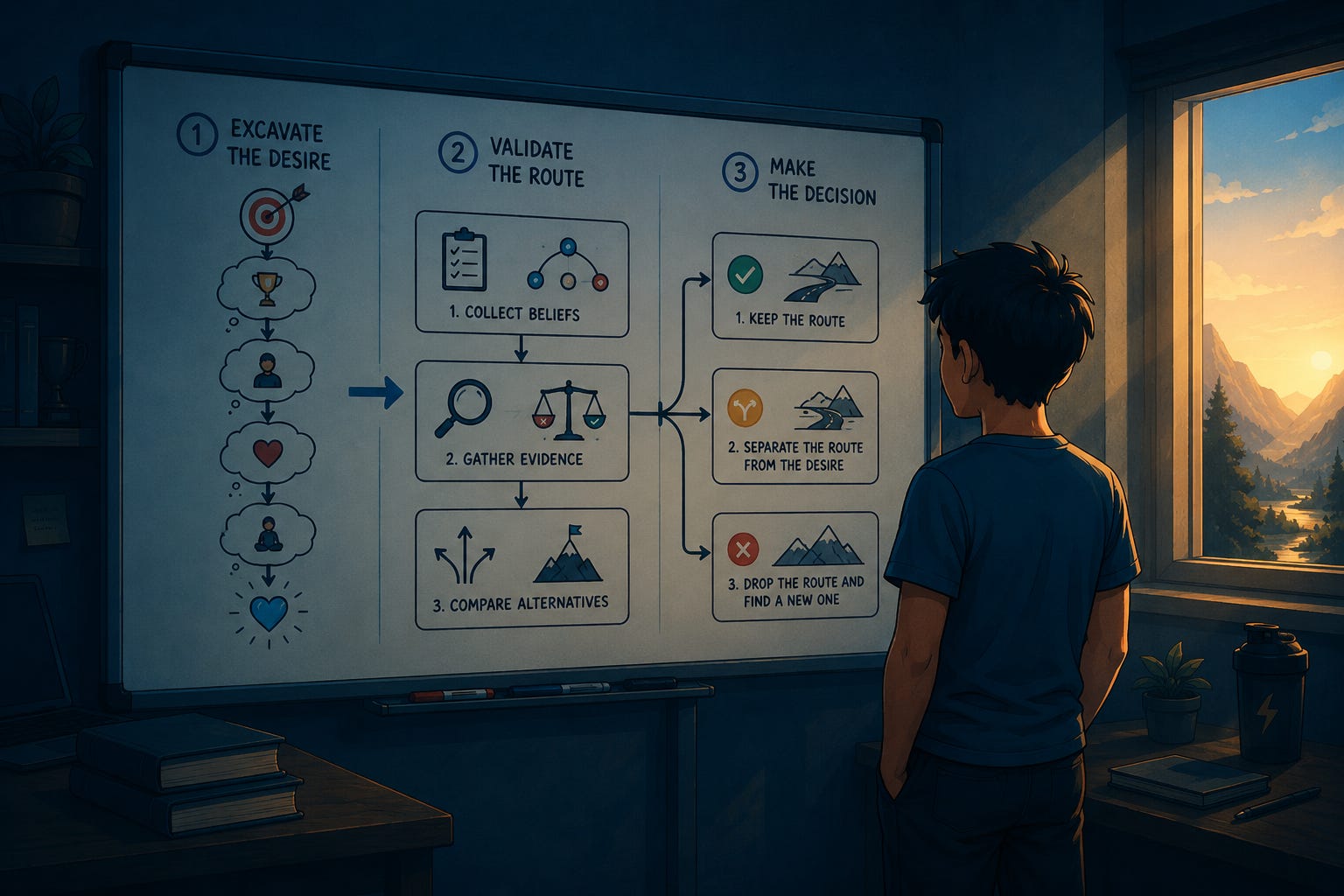
If you actually want to try the Route Audit, you don’t need to do it all manually.
I turned the entire framework into an interactive AI guide that walks you through every exercise, helping work through the audit more reliably and systematically.
I’ve made the Route Auditor free to access for subscribers »here«.
The Ferrari was never a bad car. Neither was the mountain impossible to climb. The problem was that you believed one would naturally lead to the other.
Pick a goal that would cost you years, and audit it before giving it those years.
See you next time,
Zoli
The Ferrari and mountain example hits because a lot of us chase things without asking why we want them. Sometimes we spend years trying to reach a goal, only to realize it was never going to give us what we hoped for.
The real question is not just “What am I chasing?” but “Is this actually taking me where I want to go?”
Great article, Zoli.
This route audit definitely opened up the why behind the goals I'm pursuing, and this three-step method really makes sense, especially since you applied it to your own goal of bench pressing four plates.
Very detailed and easy to understand indeed.
Thanks for the insight, and I look forward to reading more of your work! 😁